


In today’s evolving digital and AI age, qualifications alone may not be enough to open the door to clinical research, they key to success is adaptability and the ability to apply knowledge responsibly and rapidly in real-world situations.

Key insights
- Knowledge and application are different. Understanding a clinical research concept is not the same as knowing how to apply it within a particular role, workflow and set of responsibilities.
- Technology makes sound judgement more, not less, important. Professionals need to understand the tools they use, the quality of the information they handle and the limits of their authority.
- Career readiness can be developed deliberately. Candidates can identify role-specific gaps, practise relevant tasks and build credible evidence of their capabilities without misrepresenting training as employment experience.
A degree in biomedical science, nursing, pharmacy or another life science can provide a valuable foundation for a career in clinical research. Experience in a hospital, laboratory, university or healthcare setting can also bring important knowledge and transferable skills.
But there is another question worth asking: Can you apply what you know when a clinical trial presents a real-world problem?
Can you recognise what documents are missing and what needs follow-up and by when? Explain a concern clearly to the right person? Understand why a deviation matters? Work confidently with trial data and digital systems? Or judge when an issue needs to be escalated rather than handled independently?
These questions go beyond academic knowledge. They concern how a professional applies knowledge, communicates, assesses risk and makes decisions within a regulated, collaborative environment.
As clinical research evolves, these capabilities deserve more attention in career planning.
The future clinical research professional will not necessarily be the person who knows the most terminology or holds the longest list of certificates. They will need to combine a sound technical foundation with practical judgement, technology fluency, clear communication and the ability to adapt as trial methods and workplace expectations change.
This is not a prediction that qualifications will become unimportant, nor a claim that every role will require the same skill set. It is a practical way to think about career readiness in an industry where the quality of trial conduct, the protection of participants and the reliability of results matter.
For STEMM graduates, career changers, researchers, experienced professionals and people returning to work, the opportunity is to build on existing strengths while identifying the capabilities that still need development.
1. Why clinical research careers are changing
Clinical research is not simply a scientific activity. It is a coordinated process involving people, protocols, data, documentation, technology, ethics and regulatory oversight.
A trial may involve a sponsor, a contract research organisation (CRO), investigators and site teams, ethics committees, service providers and other stakeholders. Their responsibilities differ, but their work must come together to support participant safety, reliable data and the trial’s objectives.
That makes clinical research a field in which technical knowledge and practical execution need to work together.
Good Clinical Practice is evolving with the way trials are conducted
One important reference point is the International Council for Harmonisation’s ICH E6(R3) Guideline for Good Clinical Practice.
The Australian Therapeutic Goods Administration (TGA) adopted ICH E6(R3) on 16 January 2026, with an effective date of 13 January 2026 and a transition period through 13 January 2027. It replaces the previous integrated E6(R2) guideline in the Australian framework. Professionals should refer to current guidance and their organisation’s procedures when determining what applies to their work.
E6(R3) reinforces concepts including quality by design, identifying factors critical to trial quality, proportionate risk-based approaches and ensuring that trial processes and systems are fit for purpose. These principles are intended to support participant protection and the reliability of trial results.
What does this mean for career development?
It reinforces the value of understanding why a process matters, not only memorising the steps involved. A professional should be able to connect a task to its purpose, recognise when something may threaten quality, and follow the appropriate process for resolving or escalating a concern.
This does not mean every entry-level employee must interpret regulations independently or make decisions outside their authority. It means that understanding the reasoning behind procedures helps people perform their responsibilities more thoughtfully.
Technology is changing the working environment, but not removing accountability
Clinical research professionals may work with electronic trial systems, digital documentation, remote processes and increasingly sophisticated data tools. The specific technologies used will vary by organisation, study and role.
Technology can support more efficient workflows, but a digital tool does not automatically guarantee good-quality work. People still need to understand the process, assess whether information is complete and consistent, protect confidential information, and know when an issue requires human review.
The professional advantage therefore lies not simply in being able to use software. It lies in understanding how technology fits into the trial workflow and where careful human judgement remains essential.
The career question needs to evolve too
It is useful to ask, “How do I become a Clinical Trial Assistant (CTA), Clinical Research Coordinator (CRC) or Clinical Research Associate (CRA)?”
But that is only the starting point.
A more valuable question is:
What capabilities will help me perform well in my chosen role, contribute to a trial team and continue developing as the industry changes?
That question shifts career planning from collecting credentials towards building evidence of capability.
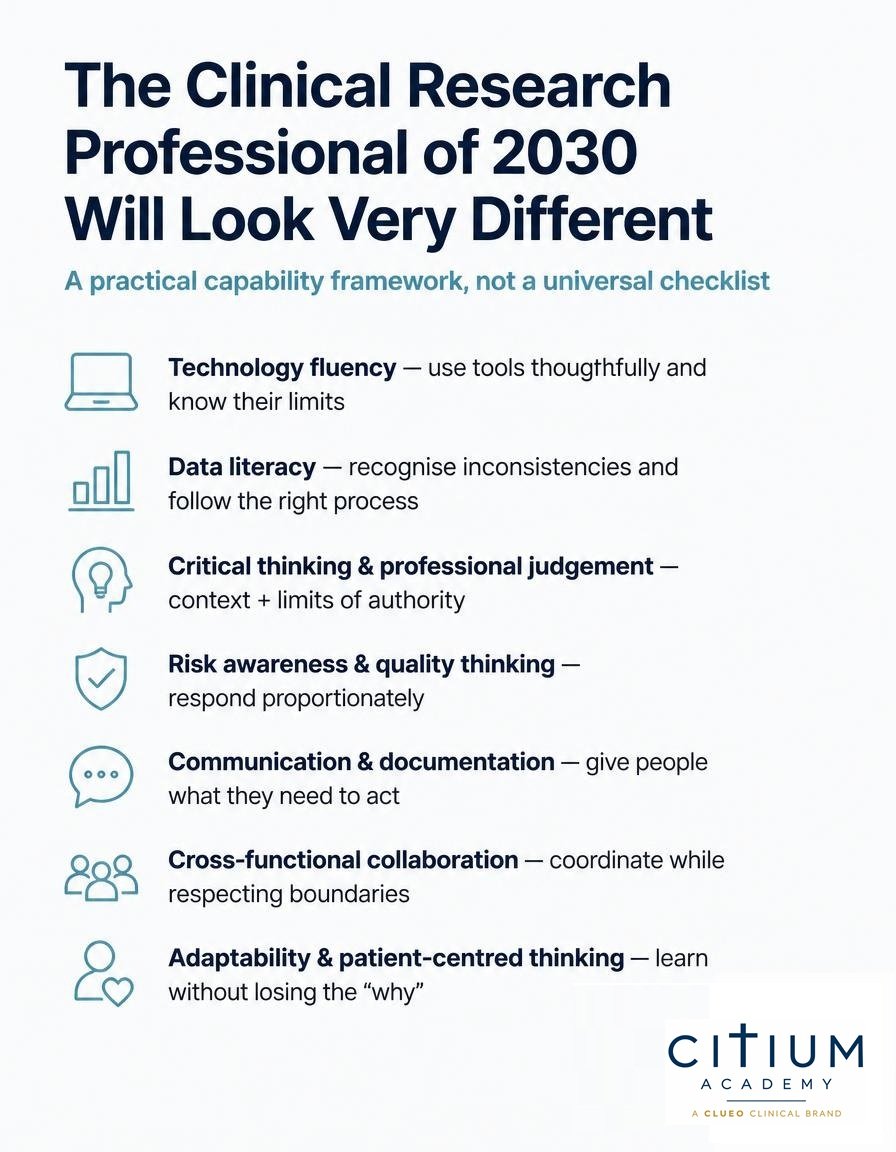
2. The seven capabilities future clinical research professionals should develop
The following capabilities are not a universal checklist for every clinical research job. Their importance and expected depth will depend on the role, level of responsibility, organisation and study.
Together, however, they provide a practical framework for thinking about professional development.
- Technology fluency
Technology fluency means being able to use relevant digital tools thoughtfully and understand their place in a clinical trial workflow.
Depending on the role, this may involve electronic trial documentation, clinical data systems, study management platforms or other organisation-approved applications.
A technology-fluent professional does more than follow instructions on a screen. They understand what the system is being used for, follow required procedures, recognise incomplete or inconsistent information and seek help when something falls outside their training or access permissions.
Practical example: A team member notices that a document appears in the wrong location or that a required record is missing from the expected workflow. Rather than assuming the system has handled the issue, they check the applicable procedure, confirm what is required and raise the discrepancy through the appropriate channel.
Technology fluency does not mean that every professional needs to code, become a data scientist or master every available platform. It means being competent with the tools relevant to their work and understanding their limitations.
- Data literacy
Data literacy is the ability to understand what clinical trial data represent, recognise inconsistencies, ask sensible questions and appreciate how data quality affects the interpretation of trial results.
Clinical research generates information that must be collected, documented, reviewed and interpreted appropriately.
It does not require every professional to be a statistician. It does require an appreciation that missing, inconsistent or inaccurate information can have consequences beyond an individual task.
Practical example: A site team member identifies a discrepancy between information recorded in source documentation and the corresponding electronic case report form. The appropriate response is not to guess which value is correct. It is to follow the study’s processes for checking the source, raising the query and ensuring that any correction is handled and documented appropriately.
The exact responsibilities depend on the person’s role and delegated duties. The broader lesson is that data should be questioned carefully, not altered to make a record appear complete.
- Critical thinking and professional judgement
Critical thinking involves understanding a situation, distinguishing facts from assumptions, considering potential consequences and identifying the appropriate next step.
In clinical research, this can mean recognising that two apparently similar situations may require different responses because the context, potential impact or applicable procedure differs.
Practical example: A document is missing from a trial file. A task-focused response may be to request the document. A more considered response is to check what document is required, whether it is applicable to the site or study, whether the absence affects a critical process, and what follow-up is required under the relevant procedure.
The professional should not independently make decisions outside their authority. Good judgement includes recognising the limits of one’s role and escalating appropriately.
- Risk awareness and quality thinking
Risk awareness means recognising that not every issue has the same significance.
ICH E6(R3) emphasises identifying factors critical to trial quality and applying processes and risk-mitigation measures proportionate to the importance of the data and the risks involved.
For professionals, this encourages a shift from treating every task as an isolated checklist item to understanding what the task protects or enables.
Practical example: A team discovers that a required process has not been completed as expected. The response should not be to conceal the omission or make an undocumented adjustment. The professional should follow the relevant procedure, document or report the issue as required, and escalate it to the appropriate person.
Risk awareness does not mean that junior staff should independently classify every issue or determine its regulatory significance. It means knowing how to recognise a potential concern and act within established responsibilities.
- Communication and documentation
Clinical research depends on people coordinating work across different roles and organisations. Clear communication helps teams understand what has happened, what remains outstanding and what action is needed.
Good documentation is similarly important. Records should be accurate, complete, timely and consistent with applicable requirements and procedures.
Practical example: Instead of sending a vague message such as “The file is incomplete,” a professional identifies the relevant document or record, explains the outstanding item, states what action is required and clarifies the appropriate follow-up timeframe where known.
This does not mean writing longer emails. It means communicating the information the recipient needs to act correctly.
Documentation and communication are not merely administrative extras. They help support continuity, traceability and effective collaboration.
- Cross-functional collaboration
Clinical research professionals rarely work in isolation. Their tasks may intersect with site staff, investigators, sponsors, CRO teams, ethics committees, data management, pharmacovigilance, quality assurance and other functions.
Collaboration requires an understanding of how individual responsibilities connect with the wider study.
Practical example: A CTA supporting document management may not be responsible for making a clinical decision. However, the CTA’s timely handling of documents and communication of an outstanding item can help the relevant team member complete their responsibilities.
Knowing when to act, whom to contact and what information to provide is part of effective teamwork.
Cross-functional collaboration does not mean taking ownership of work assigned to another person. It means coordinating responsibly while respecting role boundaries.
- Adaptability and patient-centred thinking
Adaptability is the ability to learn, adjust to new processes and respond constructively when circumstances change. It is particularly valuable when professionals move between organisations, trial types, systems or levels of responsibility.
Patient-centred thinking provides an important anchor for that adaptability. Clinical research processes are not ends in themselves; they exist within a framework intended to protect participants and produce reliable evidence.
Practical example: A new digital workflow is introduced. An adaptable professional learns the approved process, checks how their responsibilities have changed, asks questions where needed and applies the updated procedure rather than relying on habit.
At the same time, they understand why accuracy, appropriate consent processes, confidentiality and timely escalation matter to the people participating in a trial.
Adaptability is not an excuse to improvise around requirements. It is the ability to learn and respond while continuing to work within the relevant ethical, regulatory and organisational framework.
3. What these capabilities look like in different clinical research careers
The same capability can look different depending on the role. Career development becomes more effective when people connect broad skills to the tasks they may actually perform.
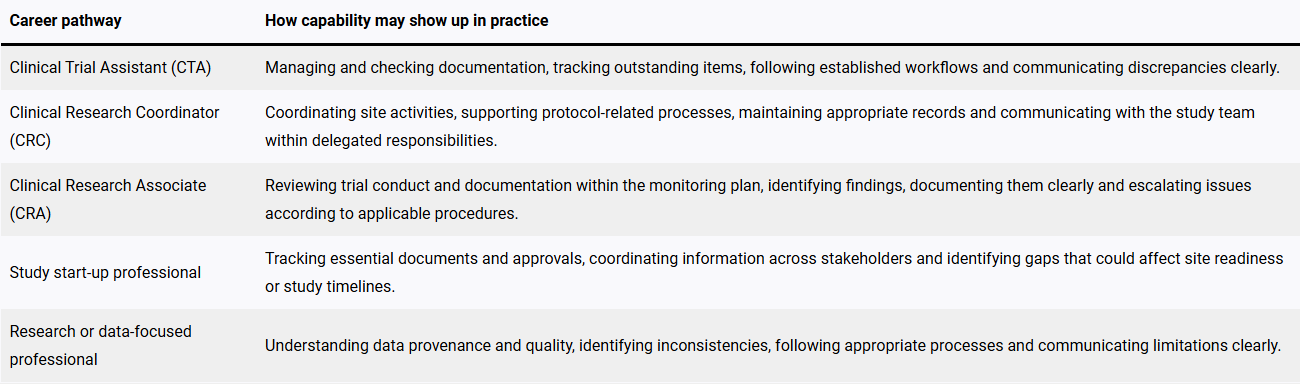
These are illustrative examples, not exhaustive job descriptions. Actual responsibilities differ between employers, studies and jurisdictions. Candidates should review the requirements of the specific position they are pursuing.
The important point is that employers need more than someone who recognises role terminology. They need people who can learn the workflow, understand their responsibilities and carry out assigned tasks reliably.
4. Why qualifications alone may not demonstrate job readiness
Qualifications matter. A relevant degree can establish a foundation in science, healthcare, research methods or clinical practice. Some positions also require particular qualifications, experience or other eligibility criteria.
However, a qualification does not necessarily demonstrate that a candidate understands the operational environment of a clinical trial.
A graduate may understand research methodology but have little exposure to essential trial documentation. A healthcare professional may be highly experienced in patient care but unfamiliar with sponsor and CRO workflows. A PhD graduate may have extensive laboratory and analytical experience but limited exposure to commercial trial operations.
These are not shortcomings in the value of their previous education or experience. They are differences in context and experience.
The theory-to-practice gap
Consider a candidate who can explain what Good Clinical Practice is during an interview.
That knowledge is valuable. But if asked to explain how they would respond to a missing document, a discrepancy in trial records or an issue requiring escalation, they may struggle to describe the practical steps.
The gap is not necessarily a lack of intelligence or commitment. It may be a lack of opportunities to practise applying the knowledge.
This is why career preparation should go beyond reading definitions and completing introductory courses. Where appropriate to the intended role, learners benefit from working through realistic scenarios, using examples of trial documentation, practising professional communication and explaining the reasoning behind their decisions.
Citium Academy’s published approach reflects this distinction between foundational knowledge and applied industry learning. Its learning pathways include Industry Foundation, Industry Catalyst and Industry-Bridging Program options, with different levels of learning and career support.
Experience matters, but it is not the only way to start building capability
Candidates without direct industry experience may assume they cannot demonstrate readiness until someone gives them their first job.
That is too limiting.
Although simulated learning is not the same as employment or a real clinical trial, well-designed practice activities can help candidates develop and demonstrate how they approach role-relevant tasks.
For example, a candidate might practise reviewing a fictional document set, identifying missing information, drafting a clear follow-up email or explaining how they would escalate a concern. They can then discuss the steps they took and why.
These activities do not replace workplace experience, formal training requirements or supervision. They can, however, help make a candidate’s understanding more concrete and provide better examples for interviews.
5. What the Australian clinical research context means for your career
For anyone seeking clinical research work in Australia, international guidance and local requirements both matter.
The TGA administers the Clinical Trial Notification (CTN) and Clinical Trial Approval (CTA) schemes for relevant clinical trials involving unapproved therapeutic goods. Under the CTN pathway, the sponsor submits the notification, and the trial also requires the relevant Human Research Ethics Committee (HREC) approval and institutional authorisation before the therapeutic good can be supplied under that pathway. The CTA pathway has a different regulatory process. The appropriate pathway depends on the circumstances of the trial.
For someone entering the industry, the lesson is not that every professional must become an expert in Australian regulatory submissions.
It is that understanding the local operating environment helps you understand how your work fits into the wider trial process.
Learn the local framework relevant to your role
Depending on the role, useful areas of knowledge may include:
- The purpose of Good Clinical Practice and how it relates to participant protection and reliable trial results.
- The responsibilities of sponsors, investigators, site teams, HRECs and relevant institutions.
- The difference between the CTN and CTA pathways at a high level.
- The role of protocols, essential records, informed consent and controlled documentation.
- The importance of following study-specific procedures and escalating concerns through the appropriate channels.
Not every point will be equally relevant to every position. Use job descriptions, current official guidance and employer expectations to prioritise your learning.
The TGA’s Australian Clinical Trial Handbook is a useful official reference for understanding the Australian regulatory framework for relevant trials.
Do not confuse international standards with every local workplace requirement
ICH guidance provides an important harmonised framework, but it does not remove the need to understand applicable Australian law, ethics requirements, institutional processes and sponsor or site procedures.
Similarly, knowing a regulation or guideline does not mean a new professional is authorised to interpret every situation independently.
A strong candidate can explain what they understand, recognise what they do not know, and describe how they would check the applicable requirements or seek guidance.
That combination of knowledge and professional humility is a practical strength.
6. How to build future-ready capability from your current starting point
You do not need to master every capability at once. A better approach is to start with your target role, assess the gap between your current experience and the role’s expectations, and build relevant evidence step by step.
Step 1: Choose a target role before choosing more training
Start by reviewing job advertisements for one or two roles you are genuinely interested in.
Look beyond the job title. Identify the tasks, systems, knowledge areas and behaviours mentioned repeatedly. Separate requirements that are essential from those that are desirable.
For example, a candidate targeting CTA roles may prioritise document management, attention to detail, communication and understanding of trial workflows. Someone pursuing CRA roles may need to focus more deeply on monitoring responsibilities, site oversight, documentation review and issue escalation.
This gives your development a clearer purpose than collecting courses without a specific career goal.
Step 2: Map your existing strengths
Your previous experience may be more transferable than you realise.
A nurse may bring patient communication, clinical documentation and an appreciation of patient safety. A pharmacist may bring medication knowledge and attention to detail. A laboratory researcher may bring data integrity, protocol discipline and analytical thinking. A professional returning after a career break may bring valuable prior experience in healthcare or research.
The next step is to translate these strengths into evidence relevant to the role, while being honest about what is new to you.
Transferable skills are a starting point—not proof that every clinical research task will be familiar.
Step 3: Identify the gaps that matter most
Compare your current capabilities with the target role’s requirements.
You may discover that your main gap is not scientific knowledge, but familiarity with clinical trial documentation. Another person may need to strengthen written communication, understand the Australian regulatory context or gain practice applying knowledge to realistic scenarios.
Prioritise the gaps that are most relevant to the position and the responsibilities you would be expected to perform.
Step 4: Practise applying knowledge
Where possible, choose learning that allows you to do more than recall information.
Useful practice might include:
- Reviewing a fictional trial document set and identifying missing or inconsistent information.
- Drafting a professional email that communicates an outstanding action clearly.
- Working through a scenario involving a potential deviation or documentation discrepancy.
- Explaining how a task connects to participant protection or data reliability.
- Describing what you would handle yourself, what you would verify and what you would escalate.
Use fictional or appropriately de-identified materials, and practise within the limits of your training. Real trial records and confidential information should only be handled with proper authorisation and safeguards.
Step 5: Build evidence you can explain in an interview
Employers cannot see everything you have learned from a certificate or course title.
Prepare concise examples that explain the situation, your approach, the reasoning behind your actions and what you learned. If the example comes from a simulation rather than employment, say so clearly.
For example:
“I completed a simulated document review. I identified that a required item was not present in the expected location, checked the scenario instructions and drafted a follow-up message identifying the outstanding item. The exercise helped me understand why clear documentation and timely escalation matter.”
That is more informative than claiming to be “detail-oriented” without evidence.
Do not present simulated activities as real clinical trial experience. Credibility depends on being clear about what you have actually done.
Step 6: Keep learning as the work evolves
Future readiness is not a one-off certificate. Guidance, systems, procedures and responsibilities can change.
Develop the habit of checking current authoritative sources, learning from feedback, asking questions and updating your understanding when your role or workplace changes.
For experienced professionals, this may mean refreshing knowledge and adapting to new systems or approaches. For career changers and graduates, it may mean building a foundation and then deepening practical skills. For people returning to work, it may mean reconnecting prior experience with current industry expectations.
The starting point differs. The principle is the same: keep your learning connected to the work you want to perform.
7. A practical 30-day plan to start preparing
The plan is a starting framework to prepare to enter the clinical research industry in a structured manner: it does not not a guarantee employment, and it is not a substitute for role-specific training.

You can download the complete plan at the link below:
Send download link to:
8. What this means for your next career move
The future of clinical research is not simply a story about new technologies or changing guidelines. It is also a story about how people learn to work responsibly within increasingly connected, data-rich and quality-focused trial environments.
For graduates, that means looking beyond the degree and building practical understanding.
For healthcare professionals and career changers, it means identifying which existing skills transfer and where clinical research requires a different way of working.
For PhD graduates and postdoctoral researchers, it means connecting scientific expertise with the operational realities of industry.
For internationally trained professionals, it means combining prior experience with knowledge of the Australian context and the expectations of the roles they are pursuing.
For experienced professionals and people returning to work, it means continuing to adapt, refresh knowledge and develop the capabilities relevant to their next stage.
No single skill guarantees a successful career, and no training program can guarantee that every learner will secure a particular role. Readiness develops through a combination of relevant knowledge, practice, feedback, experience and a willingness to keep learning.
The practical question is not whether you can predict exactly what clinical research will look like in 2030. It is whether you are developing the capabilities that will help you contribute thoughtfully as the work evolves.
Start with your target role. Understand what good work looks like. Practise applying your knowledge. Learn to communicate clearly, recognise risk and ask for guidance when needed. These are practical steps you can take now, regardless of whether you are entering the industry or developing an established career.
Where to continue learning
If you want to turn these ideas into a practical development plan, start by identifying the gap you need to close.
Citium Academy offers several learning options, depending on your starting point:
- Industry Foundation: for building an understanding of clinical research roles, industry processes and workplace expectations.
- Industry Catalyst: for developing applied understanding through practical, case-based learning.
- Industry-Bridging Programs: for people pursuing a more structured clinical research career transition with role-specific learning and career support.
Unsure which career path suits you best? Take this free career quiz to find out.
Want to understand how “industry-ready” you are and the specific gaps you need to address before your next job application? Check out this Industry Gap Diagnostic.
These options serve different needs; the right starting point depends on your background, goals and current readiness.
You do not need to learn everything at once. You need to understand what your next role requires and take a deliberate step towards being able to do that work well.
Have a question? Contact us at info@citium.academy.

Dr. Thu (Sue) Nguyen, PhD
Sue is the founder and CEO of Citium Academy Pty Ltd. She has over 17 years of combined experience in clinical and pre-clinical research and development, training and management. She is passionate about patient-centric science, clinical research, education, and helping others find their career passion and succeed in life.
She is an avid learner, an authentic networker and wants to empower the next generation to reach their fullest potential in Australia and around the world.