


You have a science degree, a nursing background, a PhD, years of healthcare experience or perhaps an entirely different professional history. You are interested in clinical research, but when you search for career opportunities, you keep seeing the same job titles: Clinical Trial Assistant, Clinical Research Coordinator and Clinical Research Associate.
It can start to feel as though these are the only doors into the industry.
Perhaps you have been told that becoming a CRA is the natural next step. Perhaps you are a nurse wondering whether your patient-care experience is relevant, a PhD researcher considering life outside academia, or a graduate struggling to find a first opportunity.
Here is something worth understanding before you choose your next move:
Clinical research is not one career. It is an ecosystem of professions that work together to bring medical research from an idea to meaningful outcomes for patients.

There are opportunities in clinical operations, data, statistics, regulatory affairs, quality assurance, drug safety, medical writing, study start-up, project management and business operations.
The challenge is not simply finding a job. It is discovering which part of the industry suits your strengths, experience and aspirations.
1. Understand where clinical research professionals work
Before you explore job titles, it helps for you to understand the three main environments in which clinical research takes place.
A. Pharmaceutical and biotechnology sponsors
A sponsor is generally the organisation that takes responsibility for initiating, managing or financing a clinical trial. This may be a pharmaceutical company, biotechnology business or medical device company.
Sponsor organisations employ or engage professionals across clinical development, clinical operations, regulatory affairs, pharmacovigilance, data management, biostatistics, medical affairs and commercial functions.
These teams work together to plan development programmes, oversee trial delivery, manage risks and evaluate research outcomes.
B. Contract Research Organisations (CROs)
A CRO provides contracted research services to sponsors. Depending on its size and service model, a CRO may support clinical monitoring, project management, regulatory submissions, data management, statistics, medical writing, safety and other trial activities.
For someone entering the industry, a CRO may offer exposure to different sponsors, therapeutic areas, study teams and operational environments.
C. Hospitals, universities and research sites
Research sites are where many clinical trials are conducted. They may be located in public or private hospitals, specialist clinics, universities, medical research institutes or dedicated clinical trial facilities.
Their teams may include principal investigators, research nurses, clinical trial coordinators, research assistants, pharmacists, data personnel and regulatory or start-up staff.
For example, Macquarie University’s Clinical Trials Unit describes roles spanning clinical trial coordination, trial administration, trainee positions, start-up and regulatory support, and finance. This illustrates how much more there is to a research unit than the people directly coordinating participant visits.
2. Explore the different clinical research career pathways
You may be familiar with the CRA or CRC roles, but consider the wider range of professional opportunities.
| Career pathway | What the professionals do | Example roles |
|---|---|---|
| Clinical operations | Help plan, coordinate, monitor and deliver clinical trials | CTA, CRC, CRA, Clinical Trial Manager |
| Study start-up and regulatory | Prepare the documentation, submissions and site activation activities needed before trials begin | Start-Up Associate, Regulatory Associate, Start-Up Manager |
| Data management | Manage clinical trial data collection, review and quality | Data Associate, Clinical Data Manager |
| Biostatistics and programming | Apply statistical methods and programming to clinical trial data | Statistical Programmer, Biostatistician |
| Medical and scientific | Support scientific interpretation, clinical development and medical communication | Clinical Scientist, Medical Writer, Medical Advisor |
| Pharmacovigilance and drug safety | Support the collection, assessment and reporting of safety information | Drug Safety Associate, Safety Scientist |
| Quality assurance | Help ensure processes and activities meet applicable quality and compliance expectations | QA Associate, GCP Auditor, Quality Manager |
| Project and programme management | Coordinate people, resources, budgets, timelines and study delivery | Clinical Project Manager, Programme Manager |
| Commercial and business operations | Support partnerships, client relationships, proposals, contracts and business growth | Business Development Manager, Account Manager |
These roles do not all have identical entry requirements. Some require specialist degrees, professional registration or substantial technical experience. Others may be accessible through relevant transferable skills and targeted development.
3. Your starting background may be more relevant than you realise
One of the biggest mistakes people make when considering a career change is assuming that their previous experience has little value because it was gained outside a CRO or pharmaceutical company.
In reality, the skills you have developed may be transferable. The important task is to understand how they connect to a new role—and identify what you still need to learn.
Consider these examples.
If you are a nurse or healthcare professional: Your experience with patient communication, clinical documentation, confidentiality, safety and multidisciplinary teams may be relevant to research-site roles such as clinical research nurse or clinical trial coordinator. Some positions require current professional registration or specific clinical experience, so check the individual requirements.
If you are a pharmacist: Your knowledge of medicines, medication safety, patient counselling and accurate records may be relevant to clinical trial pharmacy, drug safety, clinical operations or regulatory-related work.
If you are a biomedical science or life sciences graduate: You may explore research assistant, clinical trial assistant, laboratory support, data support or suitable study start-up opportunities. A relevant degree can provide a foundation, but you will still need to demonstrate that you understand the responsibilities of the role.
If you have a PhD or postdoctoral background: Your experience with research methods, scientific literature, data interpretation, critical thinking and scientific communication may be relevant to medical writing, clinical science, data-focused roles or research operations. The transition may involve learning how commercial clinical development differs from academic research.
If you are an international professional: Your previous qualifications and experience may be valuable. However, you may need to understand Australian workplace expectations, local research processes, professional registration requirements where applicable, work-rights conditions and how to demonstrate your experience to local employers.
If you are returning to work after a career break: Your professional experience does not disappear because you have taken time away. You may need to refresh technical knowledge, familiarise yourself with changes in systems and guidelines, and rebuild confidence through a realistic re-entry plan.
The point is not that every background automatically qualifies someone for every role. It is that you should assess your existing capabilities before assuming you need to start again.
4. How parallel career paths work
Imagine three people who want to become clinical operations leaders.
The first starts as a Clinical Trial Assistant in a CRO, develops monitoring and project delivery experience, and progresses into clinical project management.
The second begins as a Clinical Research Coordinator in a hospital, takes on responsibility for coordinating more complex studies, develops team leadership skills and moves into research operations management.
The third joins a pharmaceutical sponsor in a clinical operations support role, gains experience in study oversight, vendor management and cross-functional planning, and progresses into clinical trial management.
Their starting points are different. Their daily responsibilities may also be different. But each person could potentially develop the capabilities needed for a senior clinical operations position.
The same principle applies elsewhere.
A person may enter quality assurance through site documentation and compliance, while another may begin in CRO quality systems. Both may eventually develop towards quality leadership.
Someone with a statistics background may progress through biostatistics, while another may develop through clinical data management or statistical programming. Their routes may converge in senior data leadership, although the technical expertise required for each position remains distinct.
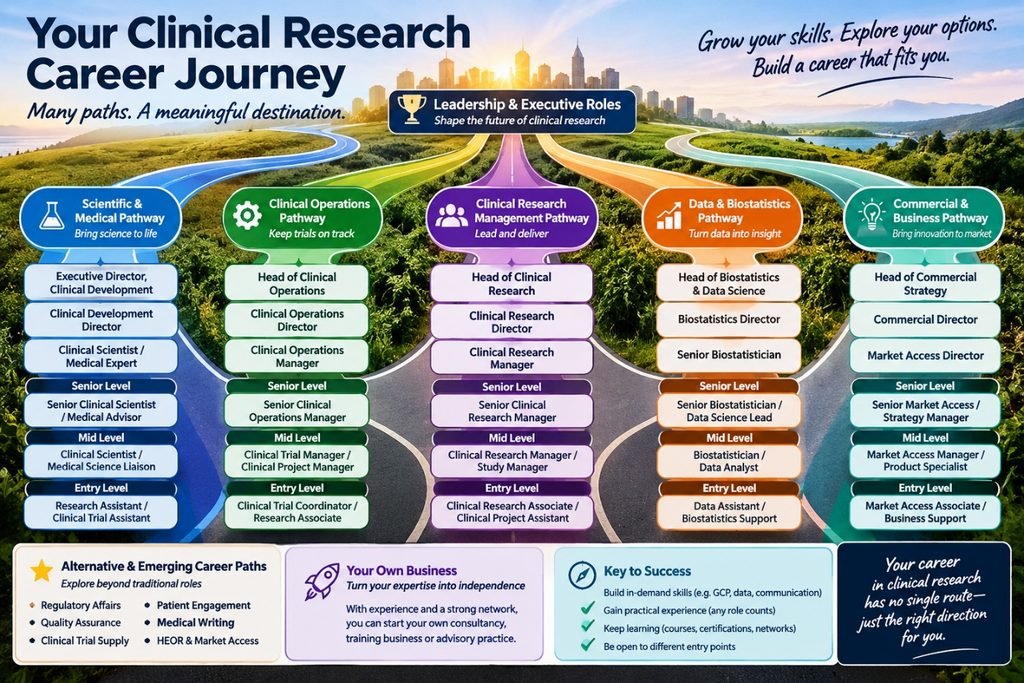
This is what we mean by parallel career paths.
Here is the underlying career architecture.
Pathway 1: Clinical operations and trial delivery
Clinical operations is one of the broadest industry career pathways.
| Level | Sponsor | CRO | Hospital / research site |
|---|---|---|---|
| Entry | Clinical Trial Associate, Clinical Operations Assistant | Clinical Trial Assistant, Site Management Associate | Research Assistant, Clinical Trial Assistant, Study Coordinator Assistant |
| Mid | Clinical Trial Manager, Clinical Operations Specialist | CRA, Clinical Project Specialist, Project Manager | Clinical Research Coordinator, Clinical Trials Manager |
| Senior | Senior Clinical Trial Manager, Associate Director | Senior CRA, Clinical Project Manager, Associate Director | Senior Research Manager, Clinical Trials Unit Manager |
| Executive | Director / VP Clinical Operations, Head of Clinical Development Operations | Executive Director, VP Clinical Operations, COO | Director of Research, Head of Clinical Trials, Research Institute Executive |
Keep in mind that a CRC does not automatically become a CRA, and a CRA does not automatically become a project manager. Upskilling is still required before progressing to the next level. These are illustrations of possible transitions that require different competencies.
Pathway 2: Medical, scientific and clinical development
| Level | Typical roles |
|---|---|
| Entry | Research Assistant, Clinical Scientist, Medical Information Associate, Medical Writer |
| Mid | Clinical Scientist, Medical Advisor, Medical Writer, Clinical Development Associate |
| Senior | Senior Medical Advisor, Clinical Development Lead, Medical Director, Therapeutic Area Lead |
| Executive | VP Clinical Development, Head of Clinical Development, Chief Medical Officer (CMO) |
Parallel routes to medical leadership:
- Medical degree → clinical practice → investigator or medical advisor → medical director → CMO.
- PhD or scientific background → research scientist → clinical scientist → clinical development leadership.
- Medical writing → senior medical writer → medical writing director → broader medical communications or development leadership.
Important distinction: a CMO role commonly requires a medical qualification and significant clinical or drug-development experience. A PhD scientist may progress to senior clinical development leadership, but that does not automatically make them eligible for a physician CMO position.
Pathway 3: Data management, biostatistics and programming
| Level | Typical roles |
|---|---|
| Entry | Clinical Data Associate, Data Coordinator, Statistical Programmer I, Junior Biostatistician |
| Mid | Clinical Data Manager, Statistical Programmer, Biostatistician |
| Senior | Senior Data Manager, Principal Biostatistician, Programming Lead |
| Executive | Director of Data Sciences, Head of Biostatistics, VP Data Sciences, Chief Data Officer |
Parallel routes to leadership:
- Data entry / data coordination → clinical data management → data operations leadership.
- Mathematics / statistics → biostatistics → statistical leadership.
- Computer science → statistical programming → programming leadership.
- Data analytics → clinical data strategy → data science leadership.
These professionals may ultimately lead the same clinical data function, even though their technical foundations differ.
Pathway 4: Regulatory affairs and quality assurance
| Level | Typical roles |
|---|---|
| Entry | Regulatory Assistant, Quality Associate, Document Control Associate |
| Mid | Regulatory Affairs Associate, QA Specialist, Regulatory Submissions Specialist |
| Senior | Regulatory Affairs Manager, Quality Manager, GCP Compliance Lead |
| Executive | Director of Regulatory Affairs, Head of Quality, VP Regulatory, Chief Quality Officer |
Parallel routes to leadership:
- Regulatory submissions → regulatory strategy → regulatory director.
- Site quality → CRO quality assurance → global quality leadership.
- Clinical operations → quality systems → compliance leadership.
This is an especially interesting career route for people who enjoy detail, systems, investigation, risk assessment and process improvement.
Pathway 5: Pharmacovigilance and drug safety
| Level | Typical roles |
|---|---|
| Entry | Drug Safety Associate, Pharmacovigilance Assistant, Safety Case Processor |
| Mid | Pharmacovigilance Specialist, Safety Scientist, Safety Operations Manager |
| Senior | Senior Safety Scientist, Safety Physician, Global Safety Lead |
| Executive | Head of Drug Safety, VP Pharmacovigilance, Chief Safety Officer |
This pathway can start in pharmacy, nursing, medicine, biomedical science or life sciences, depending on the role.
A particularly important distinction is that case processing, safety science and medical safety oversight are different areas of responsibility. Medical leadership roles may require a medical degree.
Pathway 6: Study start-up, regulatory submissions and clinical trial supply
| Level | Typical roles |
|---|---|
| Entry | Start-Up Associate, Regulatory Submissions Assistant, Clinical Supply Assistant |
| Mid | Start-Up Specialist, Country Study Manager, Clinical Supply Specialist |
| Senior | Start-Up Manager, Global Site Activation Lead, Clinical Supply Manager |
| Executive | Head of Study Start-Up, Director of Site Activation, VP Clinical Supply |
This pathway is often overlooked by graduates who think clinical research means only CRA or CRC work.
It can suit people who enjoy planning, coordination, timelines, logistics, regulatory documentation and solving operational problems.
Pathway 7: Commercial, business development and consulting
| Level | Typical roles |
|---|---|
| Entry | Business Development Assistant, Proposal Coordinator, Sales Support, Account Coordinator |
| Mid | Business Development Manager, Proposal Manager, Account Manager |
| Senior | Regional BD Director, Strategic Accounts Director, Commercial Director |
| Executive | VP Business Development, Chief Commercial Officer, CEO |
This is a parallel pathway that can lead to executive leadership without requiring someone to become a clinical operations specialist first.
People who understand clinical research delivery and can also manage customers, contracts, pricing, partnerships and business strategy can become especially valuable.
You do not need to follow someone else’s exact sequence of job titles. You need to understand the destination you are working towards and build the experience, judgement and skills that make that destination realistic.
5. Become your own boss
Another hidden career pathway that is not often discussed in mainstream career development is entrepreneurship. This is a legitimate career direction that often becomes more achievable after building specialist experience, credibility and professional relationships. For example, you may decide to create your own consulting business, become a freelancer, auditor or trainer by passing on your expertise to others. This is the path I’ve personally chosen to enable others to succeed.
Here are the main business opportunities across the clinical research ecosystem.
| Business opportunity | Relevant experience to build first |
|---|---|
| Independent CRA / monitoring consultant | Site monitoring, sponsor expectations, GCP and quality processes |
| Clinical research project management consultancy | Study delivery, budgets, timelines, vendor and stakeholder management |
| Site management consultancy | Site operations, recruitment, documentation and research governance |
| Regulatory affairs consultancy | Regulatory submissions, regulatory strategy and applicable local requirements |
| GCP / quality consultancy | Auditing, CAPA, quality management systems and compliance |
| Medical writing consultancy | Scientific writing, publication standards and therapeutic expertise |
| Clinical data consultancy | Data management, data review, programming or statistical expertise |
| Clinical research recruitment / workforce agency | Industry relationships, recruitment capability and employment compliance |
| Clinical research education provider | Deep subject expertise, learning design and demonstrable educational capability |
| Specialist CRO / FSP business | Proven delivery capability, qualified personnel, quality systems, contracts and client relationships |
| Technology / AI business | Validated problem, domain expertise, technical capability, privacy and governance |
There is no universal number of years after which someone is ready to start a business. A specialist consultant may begin independently earlier than someone establishing a CRO that takes responsibility for complex clinical trial delivery.
In Australia, the person also needs to consider business registration, tax, insurance, privacy, employment obligations and the specific regulatory requirements of the services offered. Starting a business does not remove the need for appropriate qualifications, experience or oversight.
6. The career skills that help you move between pathways
Below are highly specialised skills that can create mobility between various departments within this industry. You are not expected to have them all, but to build them progressively over the course of your career. The list below allows you to recognise when one capability creates opportunities in another department.
| Transferable capability | Where it can take you |
|---|---|
| Project management | Clinical operations, data, regulatory, start-up, commercial |
| GCP and quality understanding | Sites, CROs, sponsors, quality and compliance |
| Communication and stakeholder management | Site management, monitoring, medical affairs, project leadership |
| Data literacy | Data management, clinical operations, analytics, technology |
| Risk management | Quality, safety, regulatory, clinical operations |
| Financial and commercial understanding | Project leadership, vendor management, business development, executive leadership |
| People leadership | Department management, operations leadership, COO and CEO pathways |
7. How do you choose the right pathway?
Instead of asking, “Which clinical research job should I apply for?”, start with a better question:
What kind of work do I want to do, and where are my existing strengths most useful?
Consider the following:
- Do you enjoy working directly with people and patients? Explore research-site coordination, research nursing or participant-facing responsibilities.
- Do you enjoy organisation and making things happen? Consider clinical trial assistance, study start-up, project coordination or clinical operations.
- Do you enjoy analysis and working with information? Explore data management, biostatistics, programming or research analysis.
- Do you enjoy writing and explaining complex ideas? Consider medical writing, scientific communication or regulatory documentation.
- Do you enjoy processes, accuracy and identifying risks? Look into quality assurance, regulatory affairs and compliance.
- Do you enjoy leading people and solving operational problems? Consider project management, team leadership and, with relevant experience, broader operational leadership.
These are starting points, not personality tests. You may discover that your interests span several areas.
A practical next step is to review actual job advertisements across hospitals, universities, CROs and sponsors. Compare the responsibilities, qualifications and experience requested. Look for recurring requirements rather than assuming every employer uses the same job title or criteria.
8. How Citium Academy can help
At Citium Academy, we focus on helping aspiring and developing STEMM and Health professionals understand the clinical research industry and prepare for its expectations.
Our approach is not to tell every graduate to enrol in another course.
It is to help individuals identify where they are now, what their preferred role requires and which learning pathway may be appropriate.
Depending on your current needs, this may include:
- Industry Foundation™: Self-paced theoretical learning to develop foundational clinical research knowledge.
- Industry Catalyst™: Foundational learning combined with practical live masterclasses.
- Industry Bridging Program (IBP™): A more comprehensive learning and development pathway incorporating theory, simulations and career preparation, subject to the programme’s current entry requirements and inclusions.
These programmes are educational pathways, not guarantees of employment or substitutes for supervised workplace experience.
If you are unsure which option is appropriate, speak with our team before enrolling. We would rather help you identify the right next step than recommend a programme you do not need.
Unsure which career path suits you best? Take this free career quiz to find out.
Want to understand how “industry-ready” you are and the specific gaps you need to address before your next job application? Check out this Industry Gap Diagnostic.
These options serve different needs; the right starting point depends on your background, goals and current readiness.
You do not need to learn everything at once. You need to understand what your next role requires and take a deliberate step towards being able to do that work well.
And if your main barrier is a lack of available jobs, visa eligibility, financial pressure or the need for a recognised university qualification, we may not be the right solution. A university careers service, migration professional, recruitment specialist or local employment support service may be better placed to help.
Have a question? Contact us at info@citium.academy.

Dr. Thu (Sue) Nguyen, PhD
Sue is the Founder and CEO of Clueo Clinical and Citium Academy, bringing 20 years of experience across clinical and pre-clinical research and development, clinical operations, and education.
Guided by her Christian faith and a heart for service, Sue is passionate about helping more science reach patients by strengthening the people, operations and capabilities that make clinical research possible. She is dedicated to serving the pharmaceutical and life sciences industry while empowering the next generation of professionals to discover their God-given potential and make a meaningful difference.
An avid learner and authentic relationship-builder, Sue believes that knowledge, purpose and service can transform lives and advance science for the benefit of patients and communities worldwide.